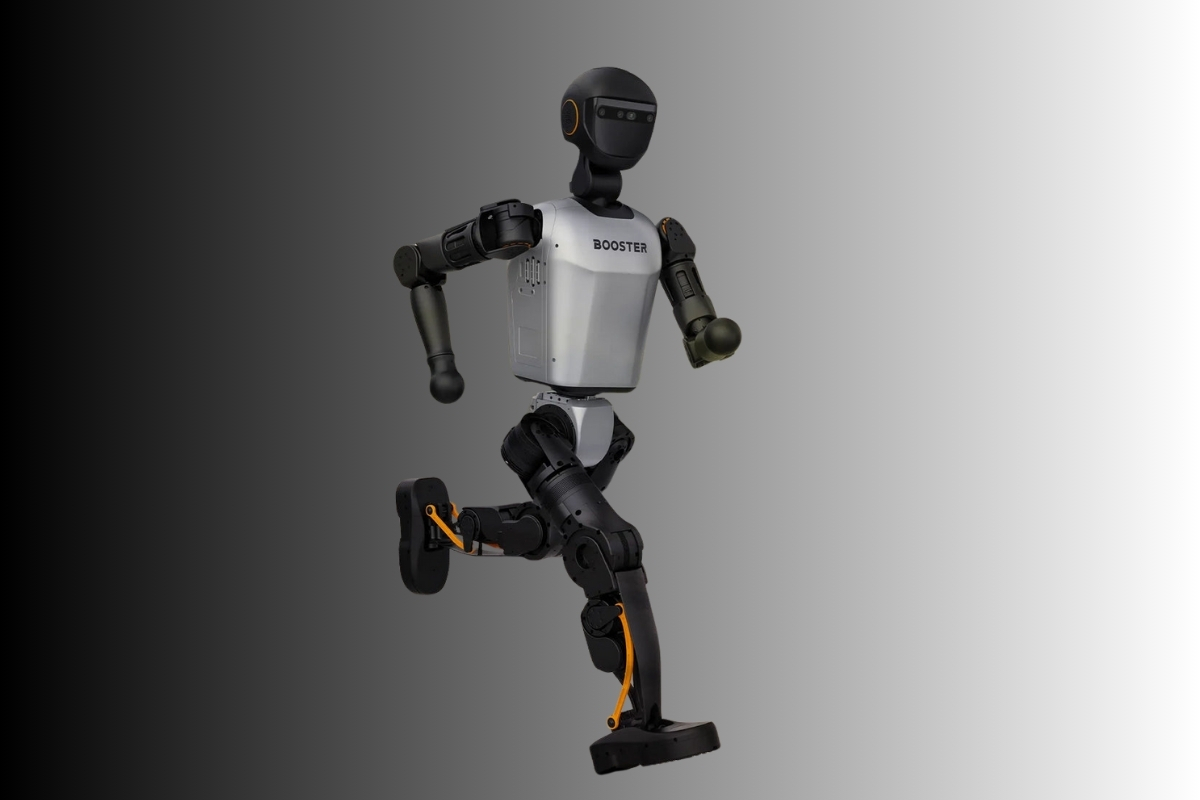
Booster Robotics’ T1 humanoid robot is a perfect reminder that looks can be deceiving. Standing at just 1.2 m tall, it may initially resemble a toy rather than a serious research platform. Turn it on, though, and that illusion disappears fast.
The reality is that this compact humanoid is one of the most resilient, robust, and capable R&D platforms currently available. In this article, we dive into Booster T1’s key strengths, its technical capabilities, how it compares to competitors, and why its smaller sibling, Booster K1, is also worth attention.
Who Are Booster Robotics (加速进化)?
Beijing-based Booster Robotics is a relative newcomer in the Chinese humanoid space. Founded in 2023 by Cheng Hao, a Tsinghua University graduate and robotics researcher, the company draws heavily on its founder’s academic background.
Cheng previously worked on Tsinghua’s robot soccer team, and that experience strongly shaped Booster’s focus: developer-friendly humanoid robots built for real-world testing, learning, and iteration. These robots are designed to support open-source tools—and, as a bonus, they perform exceptionally well in robotic football competitions and are the standard model of choice for most of the teams.
In June 2025, Booster Robotics closed a Series A funding round, backed by investors including Shenzhen Capital Group, Jinding Capital, Source Code Capital, Minyin VC, Peiport Holdings, CMBC International, Zhongguancun Science City, iCANX Fund, and Innoangel.
What Makes Booster T1 a Remarkable R&D Humanoid?
Developer-Friendly by Design
Booster T1 is built with developers firmly in mind. The platform offers deep control access, including source code and development tools, allowing researchers to deploy and adapt their own algorithms without artificial constraints.
T1 supports:
- Open APIs (high-level motion control, low-level hardware access, and status feedback)
- ROS 2
- Dedicated apps and SDKs
- Popular simulation environments such as Isaac Sim, MuJoCo, and Webots
It also enables multi-modal interaction, text-to-speech, automatic speech recognition, and vision models such as YOLO. This combination makes T1 especially popular with robotics labs, universities, and embodied-AI researchers.
Exceptionally Robust and Durable
T1 has rapidly earned a reputation for exceptional durability—and not through marketing claims alone. Videos circulating online show Booster’s team smashing bottles on its head, breaking concrete bricks on its chest, and subjecting it to repeated impact. Even independent unboxing video (including Khan’s) reinforce the same message: this robot can withstand serious shocks.
This resilience comes from a combination of:
- Advanced push and fall-recovery control systems
- Deep reinforcement learning-based control
- Hardware built from high-strength metals and engineering plastics
The result is a humanoid that can be pushed hard during development and testing without constant fear of catastrophic damage. For researchers, that means faster iteration, lower anxiety, and fewer expensive accidents.
Lightweight, Mobile and Highly Agile
T1’s performance credentials are not theoretical. In 2025, both the Gold and Silver medallists in the RoboCup Humanoid League (AdultSize category) deployed T1 robots - a strong endorsement of T1’s agility, ability to perform a variety of complex movements and reliability.
Key physical and performance highlights include:
- 23 degrees of freedom (excluding end-effectors)
- Extra-large joint movement ranges, enabling motions difficult for humans
- Weight under 30 kg, allowing a single person to carry and deploy it
- Joint torque up to 130 N·m
Despite its light build, T1 delivers strong real-time perception and decision-making. A built-in depth camera paired with NVIDIA AGX Orin (providing 200 TOPS of AI performance) supports advanced sensing, control, and autonomy. Combined with an extensive soccer skill and motion library, T1 is a highly capable R&D platform out of the box.
Importantly, Booster also offers a range of end-effectors with varying degrees of freedom, enabling researchers to work not only on locomotion and human–robot interaction, but also on manipulation algorithms using the same platform. If you would like to discuss T1 and/or any of its alternatives in more detail, don’t hesitate to contact us.
Booster T1 Humanoid: Key Technical Specifications
Below is a consolidated overview of Booster T1’s main specs. For more information on how to compare technical specs, see our blog post here.
Form Factor
Smaller size (1.2m), lightweight (30kg) humanoid designed primarily for R&D labs. However, it can also support some industrial use cases when combined with the right end effector.
Dimensions
- Height: 118cm
- Weight: 30kg
- Width (Shoulder): 47cm
Speed
~7.2km/h, but can be developed into higher speed
Strength
- Single arm payload: 0.5kg
- Peak torque: 130 N·m
Flexibility
- 23 DoF excluding end effectors
- 4 DoF single arm (extendable)
- 6 DoF single leg
- 2 DoF neck
- 1 DoF waist
- Compatible with 2-finger gripper & dexterous hands.
Flexible, precise, and capable of complex manipulation tasks.
Reliability
Booster T1 is exceptionally reliable and robust, able to withstand a lot of accidental (or not) interference and force.
Battery & Endurance
- 9,500mAh Lithium-ion polymer swappable battery
- ~2h (walking), ~4h (standing) battery life
- ~2 hours charge time
Sensors
- 9-axis IMU
- Depth camera
- Circular 6-Mic Array + Speaker
Computing Power and Communication
- GPU: Nvidia AGX Orin, 200 TOPS AI performance
- Wifi 6, Bluetooth 5.2, USB
Price Range
$30,000–$50,000
How Does Booster T1 Compare to Similar Humanoids?
The last few years have seen rapid growth in the number of humanoid robots entering the market, many of them explicitly targeting R&D and research-lab use cases. Below are some of the most relevant models worth calling out, and how they compare to Booster T1.
Booster K1 (China)
Booster K1 is T1’s younger sibling. Standing at just 95 cm tall, it weighs under 20 kg, features 22 degrees of freedom, and delivers the same impressive durability that Booster has become known for.
K1 was the champion of the 2025 RoboCup Soccer “KidsSize” category, and its EDU version matches T1’s computing and sensor stack, making it a surprisingly capable platform despite its compact form factor. With a starting price around USD 6,000, K1 is particularly appealing for teams seeking strong value for money in an entry-level R&D humanoid.
Unitree R1 (China)
Unitree R1 is closest to Booster T1 in size and agility, while being slightly lighter at around 25 kg and priced much lower (closer to Booster K1 price point). However, R1 trails Booster’s platforms in several important R&D-relevant areas.
R1’s battery life is shorter (typically ~1 hour), its durability is more limited, and its computing capabilities are also lower. Even in the EDU configuration, compute is optional, with NVIDIA Jetson Orin (roughly 40–100 TOPS) offered as an upgrade. As a result, R1 supports a narrower range of research workflows. In addition, buying R1 necessitates a degree of patience, as its dispatch times are quite long.
By contrast, T1 (and K1) are not only strong entry platforms but also support a broader R&D ecosystem, extending into more advanced research domains than R1 comfortably enables.
Unitree G1 (China)
Unitree G1 is slightly larger (~1.3 m) and heavier (~35 kg) than Booster T1. It offers more out-of-the-box sensing, most notably 3D LiDAR, and benefits from exceptional visibility and a very active global community.
Booster T1, on the other hand, is stronger (higher peak joint torque), more durable, and ships with more powerful onboard computing. This combination makes T1 a more forgiving, “guilt-free” R&D platform—one you can push hard, bash, or occasionally drop (accidentally or otherwise) without losing sleep or bricking an expensive research asset.
LimX TRON 1 And 2 (China)
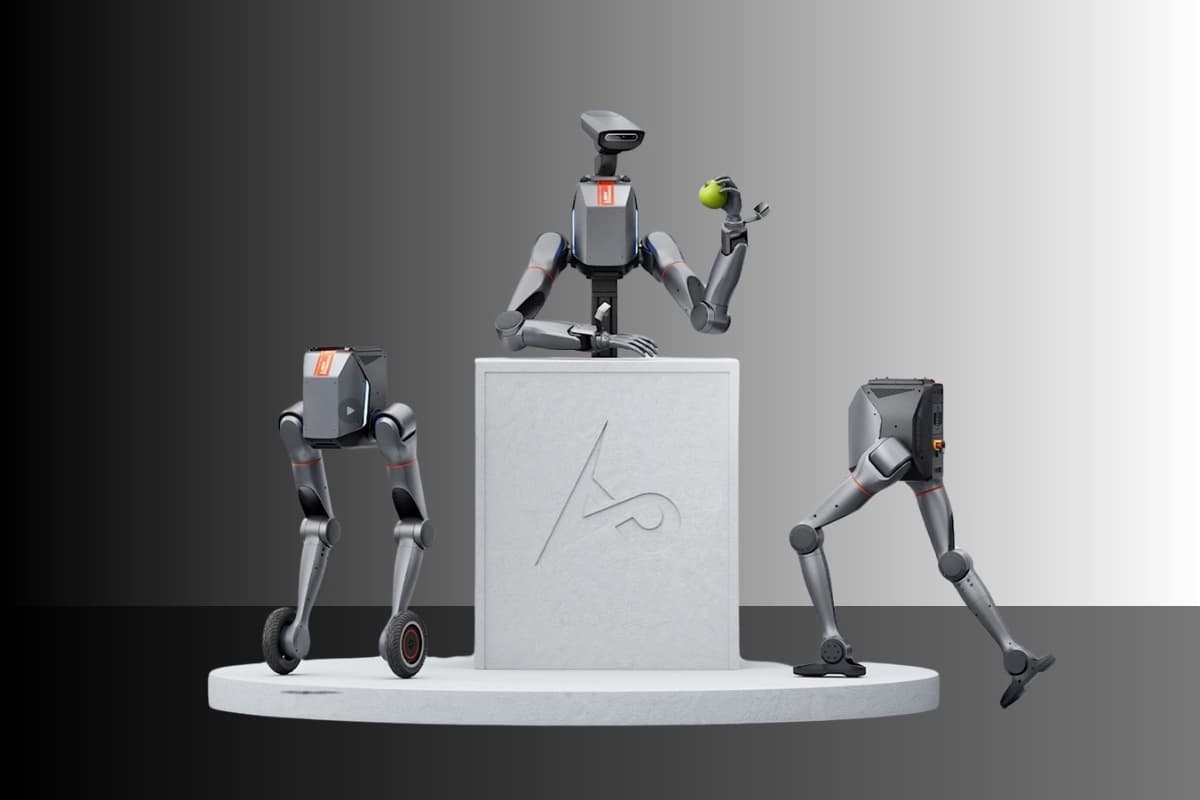
TRON 1 is one of the most impressive R&D platforms on the market, thanks to its 3-in-1 design, with easily swappable feet and expansion packs. That said, it is fundamentally a bipedal platform, and requires additional modules to move beyond locomotion-focused research.
TRON 2, scheduled for dispatch in early 2026, enables a much broader range of R&D use cases than T1. However, achieving a full-size humanoid configuration requires two TRON 2 units to be combined, effectively doubling system cost and complexity. If budget allows, this setup would be a genuine R&D dream machine—but it sits in a different cost and complexity bracket.
LimX OLI (China)
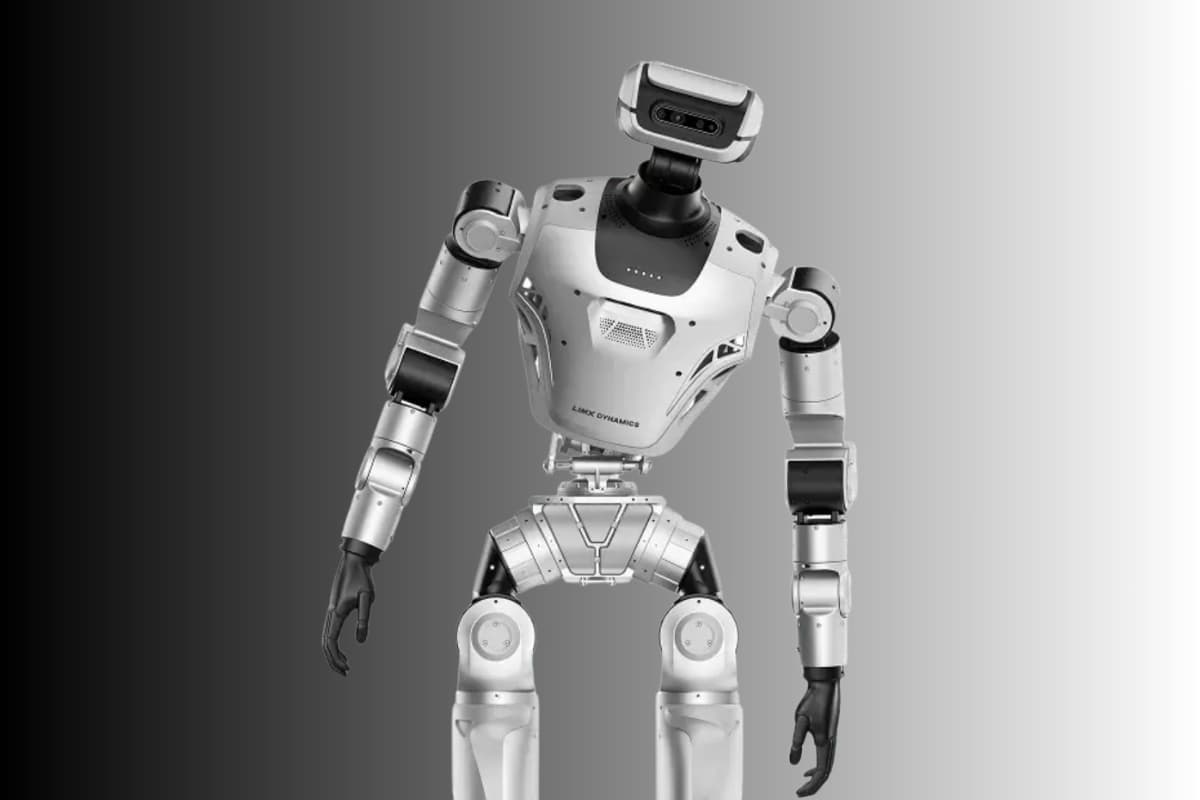
Compared to OLI, Booster T1 is a smaller (1.2 m), entry-to-mid-tier R&D platform competing for similar research budgets. T1 is simpler and therefore well-suited for teaching, early-stage research, and lightweight motion studies.
OLI, by contrast, is a more flexible and higher-capability platform, with 31 DoF versus T1’s 23 DoF, making it better suited to advanced loco-manipulation, whole-body AI research, and early industrial experimentation.