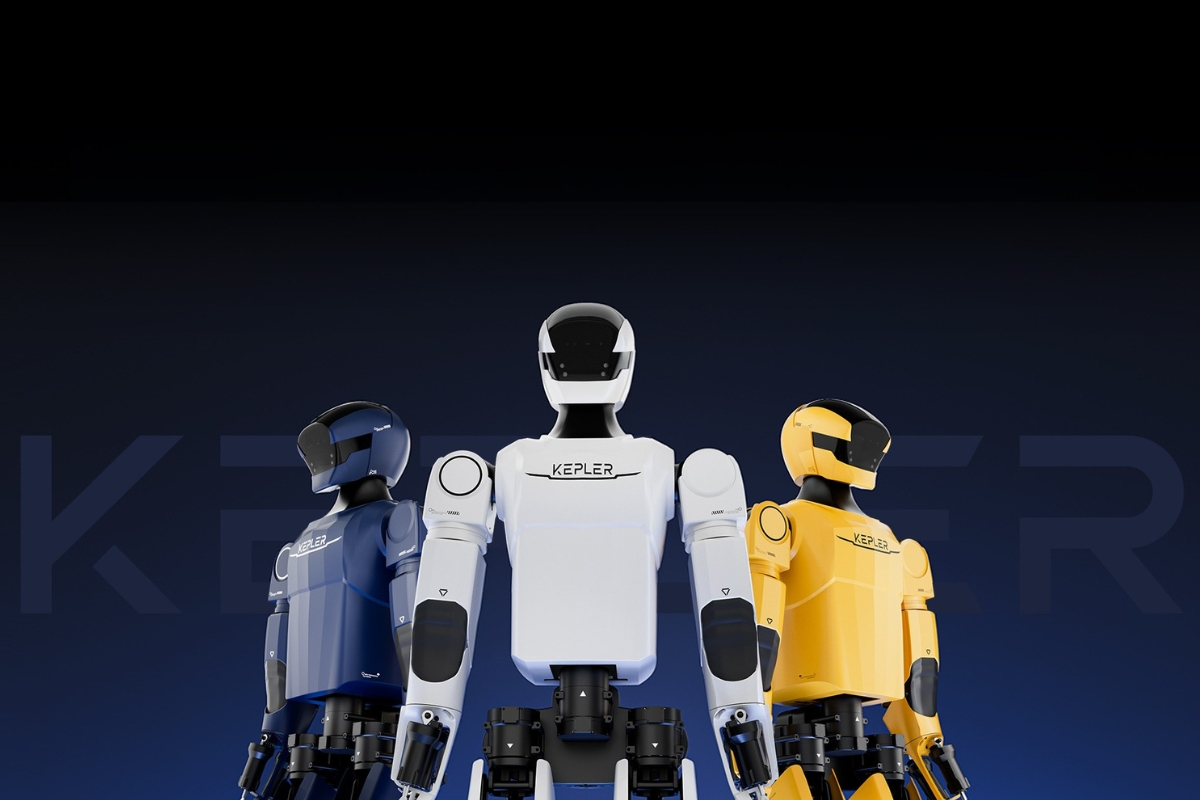
Some humanoid manufacturers excel at publicity. Others quietly build excellent machines and let their robots do the talking. Once you see Kepler’s K2 in action, you understand why industry insiders whisper about it and why its demo videos circulate in engineering circles. Kepler K2 is one of those Chinese humanoid gems: not yet widely known in the West, but with dual-form hardware specifications industry innovators should seriously consider.
Who is Kepler Robotics (开普勒)?
Kepler is a rising star in China’s humanoid robotics scene. Founded by Yang Hua - founder of Chinese tech giant Xiaomi’s smart home core supplier Chunmi Tech - in August 2023, the company made its global debut at CES 2024 in Las Vegas. By early 2025, the Kepler K2 was already undergoing real-world testing at SAIC-GM’s automotive plant in Shanghai. Kepler is known for its advantages in hardware design and supply and its focus on industrial applications.
In June 2025, Kepler closed a Series A round backed by major industrial investors including Zhaofeng, Hanwei, Jirfine Intelligent Equipment, Veichi and Keli Sensing. The company has since signed strategic cooperation agreements with SAIC-GM, Flender, SIMPPLE (Singapore), and other enterprise partners to explore humanoid robot applications in security patrols, property services, and industrial manufacturing. As of September 2025, Kepler announced that the K2 “Bumblebee” variant had officially entered mass production.
What Makes the Forerunner K2 “Bumblebee” a Remarkable Industrial Humanoid Robot?
Proprietary Actuators
K2 uses a hybrid system of planetary roller screws and high-torque rotary actuators — an unusually advanced design at this price point. This architecture delivers high stiffness (joints behave like solid, precise mechanisms) and low backlash (immediate, smooth directional changes). The result: excellent positional accuracy, load stability, smooth motion, and high reliability in repetitive industrial workflows. In short, K2 is built to lift, carry, and manipulate objects in real factory conditions.
Sensory and Control Stack
Each fingertip carries 25 tactile sensing points, giving K2 unusually fine grip control. Paired with high-resolution proprioception and a reinforcement-learning control layer trained through digital-twin simulation, the robot moves with stability and naturalness even in messy, vibration-heavy environments. It can feel, adjust, and execute with impressive finesse.
Operational Endurance
K2 is clearly engineered for industrial deployment. It offers up to 8 hours of runtime, a ruggedised frame, and 52 Degrees of Freedom (30 excluding end effector). It is well suited to manufacturing, logistics, and inspection environments requiring repetitive, multi-step workflows.
Competitive Pricing
Kepler K2 retails at roughly €80,000 for the bipedal edition and €85,000 for the dual-form edition (bipedal + wheel base), close to the cost of a small industrial arm. Its design is clearly optimised for cost-effective mass manufacturing, giving it an exceptional balance of performance, robustness, and scalability. For precise pricing based on your region, feel free to contact us.
Tested in the Real World
Kepler K2 robots were deployed at various companies performing material handling. Since September 2025, Kepler K2 robots have been operating in a SAIC factory, mainly handling the transportation of 20 kg material bins. At the end of 2025, K2 were also deployed on a production line at HZF (a publicly listed car parts manufacturer), primarily responsible for loading and unloading automotive wheel hubs.
Kepler K2: Key Technical Specifications
Below is a consolidated overview of the K2's main specs. For more information on how to compare technical specs, see our blog post here.
Form Factor
A general-purpose industrial humanoid designed for factory floors. Kepler also offers a 4-wheel omni-direction mobile base and multiple end-effector attachments.
Dimensions
- Height: 175 cm
- Width: 57 cm or 82 cm with chassis
- Weight: 75 kg or 135 kg with chassis
Speed
1 m/s or 3.5 km/h walking or moving speed — not built for racing, but steady and reliable for industrial tasks.
Strength
- Payload: 30 kg (two-arm)
- Peak force: 8200 N
- Peak torque: 220 N·m
This puts K2 firmly in the “heavy industrial handling” category.
Dexterity
- 30 DoF excluding end effector
- 52 DoF including dexterous hands (11 total DoF, 6 active DoF per hand)
- Force/Torque sensors in wrists
Flexible, precise, and capable of complex manipulation tasks.
Battery & Endurance
- 51.8 V, 30 Ah swappable ternary lithium battery
- 8 hours runtime
- ~1 hour charge time
Very few humanoids match this endurance today.
Robustness
- IP54
- Operating temperature: –10°C to 45°C
- Up to 85% non-condensing humidity
- Drop resistance: 0.5 m
A genuinely ruggedised system for industrial environments.
Price Range
€80,000 - €85,000 (Shipping, taxes, and import duties vary by region.)
How Does Kepler K2 Compare to Tesla Optimus and Other Industrial Humanoids?
Tesla Optimus (USA)
A close rival in purpose and design, Optimus' dimensions, payload, and endurance are comparable. Tesla is faster (~2×), but K2 is more rugged (IP54, shock tolerance). Kepler is also far more price-competitive and has already begun mass production, while Optimus remains a private platform on Tesla’s factory floor.
Galbot S1 (China)
Galbot S1 may be the only wheeled humanoids that equals or excels K2 in most of the dimensions. Designed for heavy-duty industrial work, S1 has 30+kg peak payload, 8h battery life with autonomous battery swap and IP54 rating, but comes at a much higher price of $150,000 / €130,000.
Figure 02 (USA)
Operational in BMW’s Spartanburg plant. Similar dimensions and strong performance but has shorter battery runtime (4–5 hours) and comes at roughly three times the cost of K2.
Unitree H2 (China)
A full-size commercial humanoid, about twice as fast as K2, but with shorter runtime (2–3 hours) and long lead times for order fulfilment.
Fourier GR-2 (China)
Strong on dexterity but limited in strength (3 kg per arm) and battery (~2 hours). More appropriate for lighter industrial and healthcare tasks than heavy factory work.
Wheeled Alternatives: Agibot G1 and Galaxea R1 Pro (China)
Excellent for warehouse logistics with strong teleoperation capabilities, but K2 remains significantly stronger with much higher total payload.
Technical FAQs
What Is a Planetary Roller Screw (PRS)?
A high-precision mechanism converting motor rotation into linear movement, enabling strong, precise pushing, pulling, lifting, and force application.
What Is a High-Torque Rotary Actuator?
A compact motor-gearbox unit delivering high rotational force at low speed, helping the robot stay stable when lifting or manipulating objects.
What Is a Reinforcement-Learning Control Layer Trained via Digital Twin?
The robot learns movement, balance, and manipulation inside a virtual replica of itself and its environment — performing millions of high-speed simulations and refining its behaviour far beyond what hand-coding could achieve.
What Is a Ruggedised Frame?
A structurally reinforced body designed to resist torsion, vibration, impacts, and dust/water ingress — essential for factory reliability.
What Is a Degree of Freedom?
One axis on which a joint can move or rotate. More DoF = greater dexterity and human-like motion.
What Is an End Effector?
The functional “tool” at the end of the arm — such as a robotic hand, gripper, suction tool, welding torch, drill, or specialised industrial clamp.